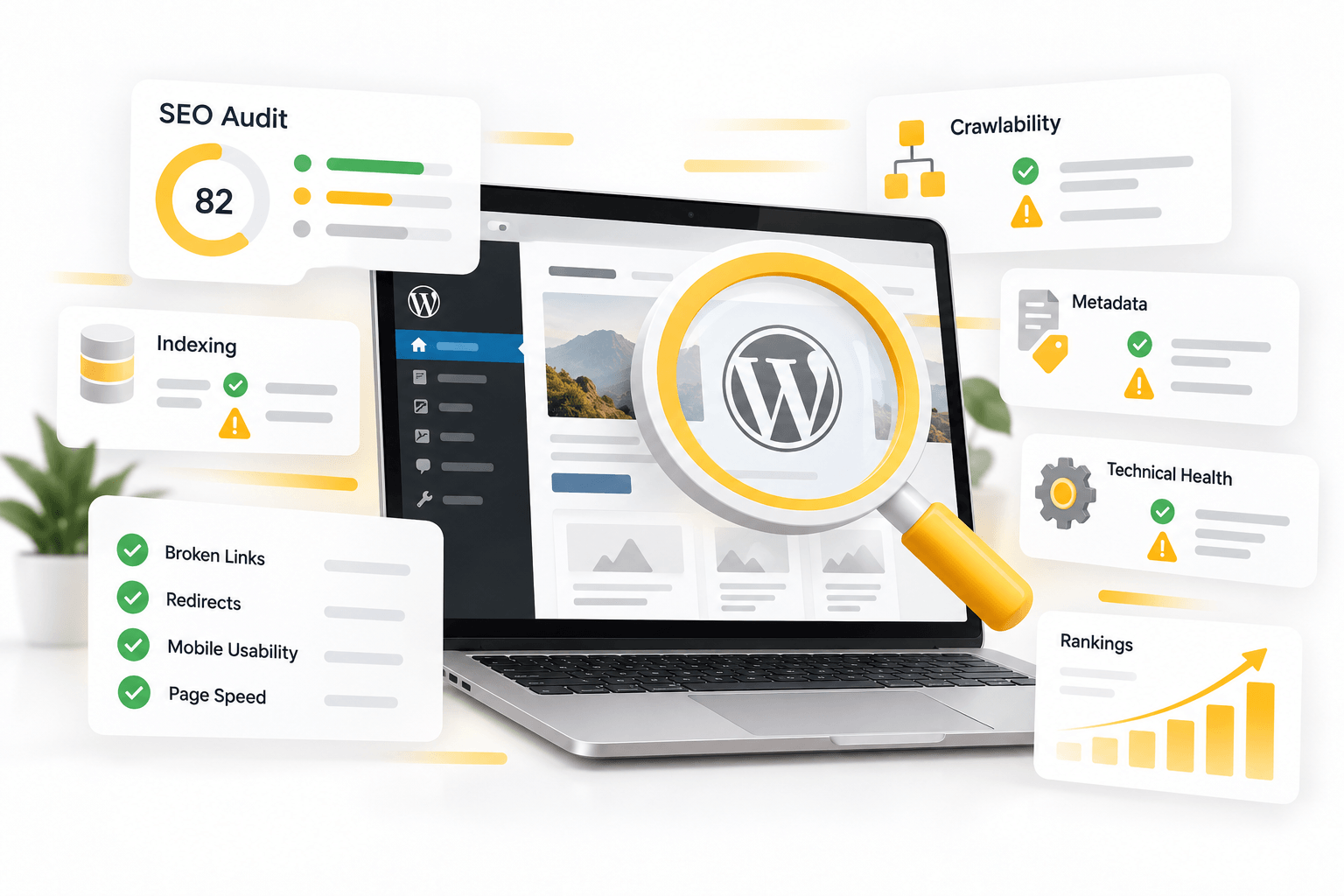
A website can look polished and still remain almost invisible in Google. Businesses often respond by rewriting pages or publishing more content without knowing whether the real problem sits deeper. A WordPress SEO audit helps uncover those hidden issues before more budget is spent on the wrong fixes. Good WordPress development and WordPress SEO optimization starts with evidence. Crawlability, structure, internal links, metadata, performance, and content quality all influence whether search engines can understand a website.
Why the SEO audit should come before more content
Publishing more pages will not solve structural problems. If Google cannot crawl key sections, important pages compete with each other, or metadata is inconsistent, more content can simply add noise.
A WordPress SEO audit gives you a baseline. It shows what is blocking visibility and which changes are most likely to matter. That makes WordPress SEO optimization more efficient because decisions are based on actual problems rather than generic recommendations.
This matters especially for sites that have gone through redesigns, migrations, plugin changes, or periods of WordPress development. A proper WordPress SEO audit can reveal technical problems that are almost impossible to notice from the front end.
WordPress SEO audit starts with crawlability and indexing
Robots.txt settings, noindex tags, canonical URLs, XML sitemaps, redirects, and plugin configurations can all affect visibility. During WordPress development, these settings are often changed for staging or testing. If they are not restored correctly, finished pages can remain hidden from search engines.

A WordPress SEO audit should compare what exists on the website with what Google is actually indexing. WordPress SEO optimization becomes easier once unnecessary exclusions, duplicate URLs, and incorrect canonical signals are cleaned up.
Search Console shows how Google sees the site. A WordPress SEO audit should use that data alongside a technical crawl instead of relying only on what looks correct in a browser.
WordPress SEO optimization depends on structure, not just keywords
Page hierarchy, headings, internal links, URLs, and navigation explain which topics matter most and how pages relate.
Several pages may target almost the same search intent. In that situation, WordPress SEO optimization is not about repeating a keyword more often. It may require merging pages, changing internal links, or deciding which URL should become the main authority.
A WordPress SEO audit can identify keyword cannibalization and pages that receive impressions but fail to rank strongly. It can also expose orphaned pages with few internal links, giving search engines little indication that those pages matter.
WordPress development also influences this structure. Templates determine heading hierarchy, breadcrumbs, archives, and how links are generated. Strong WordPress SEO optimization therefore requires content and technical implementation to work together.
Metadata still matters when SEO optimization is done properly
Page titles and meta descriptions do not guarantee rankings, but they influence how search engines interpret pages and how users respond to search results.

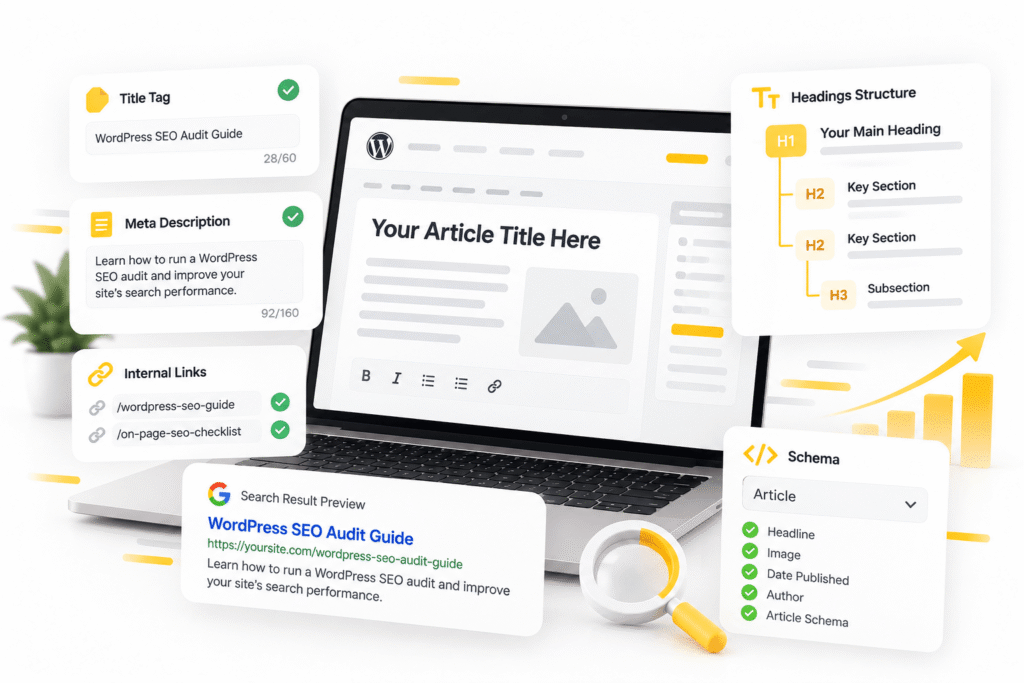
A WordPress SEO audit should check whether titles are unique, relevant, and aligned with search intent. It should also review headings, image alt text, schema markup, and other signals that clarify each page.
The goal of WordPress SEO optimization is not to fill every field. It is to remove ambiguity. When titles, headings, content, and structured data tell the same story, search engines understand the page more confidently.
Poor WordPress development can create metadata problems at scale. A theme or plugin may generate duplicate archives or apply one title pattern across hundreds of pages. A WordPress SEO audit helps separate isolated content issues from template-level problems.
Performance can undermine WordPress SEO optimization
A page can be relevant and indexable while still delivering a poor experience. Slow loading, layout shifts, heavy JavaScript, and weak mobile performance can make search performance harder to improve.
This is where WordPress SEO optimization overlaps with performance work. Large images, excessive plugins, third-party scripts, and inefficient themes can affect users and search engines. A WordPress SEO audit should therefore look at Core Web Vitals alongside crawl and content data.
WordPress development choices matter here too. Good WordPress development balances visual requirements with speed and maintainability instead of loading unnecessary scripts everywhere.
If performance is a major bottleneck, our website speed and performance optimization service focuses on finding and fixing technical causes behind slow WordPress and WooCommerce sites.
A WordPress SEO audit should lead to priorities, not a giant checklist
One of the biggest mistakes in SEO is treating every warning as equally urgent. A missing image attribute and a site-wide indexing problem do not deserve the same priority.
A useful WordPress SEO audit ranks problems by likely impact, effort, and business importance. That allows WordPress SEO optimization to begin where it can produce meaningful results fastest.
For one website, the priority may be indexing and redirects. For another, it may be reorganizing service pages or strengthening internal links. Sites with solid content but weak foundations may need WordPress development before more copywriting makes sense.
WordPress SEO optimization works best when technical, content, and commercial goals are connected. The better question is whether a change helps search engines understand the site and helps the right visitors reach the right page.
Finding the real constraint
Ranking problems are rarely caused by one dramatic mistake. More often, several smaller issues combine: weak internal linking, inconsistent metadata, slow templates, duplicate content, poor indexation, and pages targeting the same intent.
A WordPress SEO audit brings those issues into one picture. From there, WordPress SEO optimization becomes a focused process rather than a sequence of guesses.
This is also where experienced WordPress development adds value. Some SEO problems are editorial, while others sit inside templates, plugin logic, or site architecture. Another WordPress SEO audit can confirm which problems require content changes and which require technical work.
The purpose of WordPress SEO optimization is not to chase perfect scores. It is to make the website easier to crawl, understand, use, and match with searches that matter commercially.
That is exactly what a WordPress SEO audit should uncover. A thorough WordPress SEO audit gives you the evidence needed to do exactly that. WordPress SEO optimization can then focus on the changes that matter most. Strong WordPress development can fix structural problems at their source, while a final WordPress SEO audit confirms whether the main barriers have actually been removed. Reach out to us to help you with your WordPress SEO audit and optimization and learn useful tips to boost your website from our LinkedIn.